
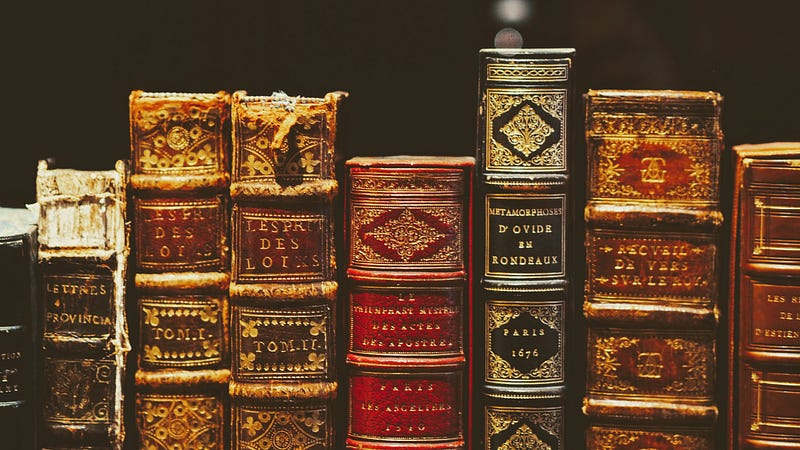
The famed author, C.S. Lewis, encouraged readers to maintain a healthy diet of books, properly balanced between new and old.
In his “Introduction to Athanasius’ On The Incarnation”, Lewis writes,
It is a good rule, after reading a new book, never to allow yourself another a new one till you have read an old one in between. If that is too much for you, you should at least read one old one to every three new ones.
Since stumbling upon Lewis’ idea in The Wisdom Pyramid, I realized that I have a bias towards reading new books. When I add in my consumption of articles—which, by natural bias of their medium, are new—the bulk of my reading is new material. Like a diet made up of fast-food chicken nuggets and french fries, my reading diet is not what I would call “chronologically-balanced.”
So, this year, I want to read some old books.
Why should you read old books?
There are undoubtedly many reasons to read old books, but below are a few of the benefits that I find most important in our time.
To allow you to read the gold.
Just last week, my wife texted me letting me know my copy of Nicomachean Ethics (that a friend and I are endeavoring to read together) had arrived. She informed me that “it looked boring.” Jokingly, I told her that as boring as it may be, it was over 2,000 years old, so it clearly had something going for it.
In an age of instantaneous “trends”—which are literally here today and gone tomorrow—reading old books allows us to read the gold that has been sifted out by the pan of Father Time.
Lewis hits on this reality noting,
A new book is still on its trial and the amateur is not in a position to judge it.
All new ideas—not just books—are still on trial. Reading old books allows us to read the ones that have been declared “good” by more than our Aunt Joan or the Instagram influencers we follow.
To challenge your chronological blind spots.
Lewis is well known for his idea of “chronological snobbery,” which “is the uncritical acceptance of the intellectual climate common to our own age…” Like a the fish that says, “what’s water,” we have difficulty transcending our cultural moment to see those things which we are getting wrong.
Lewis argues…
Every age has its own outlook. It is especially good at seeing certain truths and specially liable to make certain mistakes. We all, therefore, need the books that will correct the characteristic mistakes of our own period. And that means the old books.
Like a good friend, who gently points out our blind spots, old books can help us transcend our time to see where we may be erring.
Lewis beautifully asserts that…
The only palliative is to keep the clean sea breeze of the centuries blowing through our minds, and this can be done only by reading old books.
To slow you down.
Let’s be honest, reading old books is hard.
On our annual trip to the beach this year, I took Frankenstein with me to read. I made it about 10 pages in and had to move on to something else. Frankly, it was too intellectually demanding for me to read at the beach (not to mention the full house with 7 kids running and screaming at any given moment).
Old books—especially literature—require a slower, more methodical reading than the latest self-help book that hit the shelves.
Old books aren’t skimmable. They’re not written in listicle-form. There are no images, no tweet-threads, and no TL;DR’s.
Old books require much of your time and attention.
But amidst a deluge of information, and an all-out-assault on your attention, a slow read may be precisely what you need.
The 100-Year Reading Challenge
So, what’s the challenge?
To keep the “score” of all your completed books under 1923 (100 years old). If you need a sports analogy, think of it like golf—the lower your score the better.
The Scoring System
There are certainly simpler ways to balance out your book diet (see C.S. Lewis’ recommendations above), but for my own enjoyment, I wanted to create a system that left a little flexibility (even if it’s needlessly complex).
Couldn’t you just average the published dates of all the books? You can, and that’s one of the options that can be utilized in the log below. But, through testing some books out, I discovered that if you read one really old book, you could read a host of new books. For instance, if you were to read City of God by St. Augustine, you could then read 15 books published in 2021. If you don’t plan to read some really old books, then the simple average may be sufficient.
Nonetheless, there are three different options in the log to choose what may best suit you.
OPTION 1
Books newer than the year 2000 are weighted 1.5x; books newer than the year 1924 are weighted 1.25x; books equal to and older than 1923 are weighted 1x.
This is the scoring system that I will utilize.
The reason I developed it as such is that it pushes my reading to older books (really old), yet still allows for flexibility to read newer stuff. And if I read something new, it better be worth it.
OPTION 2
All books newer than 1924 are weighted 1.33x. Books equal to and older than 1923 are weighted 1x.
OPTION 3
This is the simplest of them all, taking the average of the year each book was published.
Using the Log
If you’re interested in doing the reading challenge, then feel free to use the log below. You simply open it up, click file, then click make a copy, and you have your very own old book log to hammer away at.
https://docs.google.com/spreadsheets/d/1b1H4sIIPvyydoxEhFAXjC6TcX5MVGLoJtHCQIMv91lM/edit?usp=sharing
The various options each have their own tab, so you can use whichever would be the best path for you in your reading journey this year.
If you are having trouble finding old books, there is a ‘Resources’ tab that has a couple links to see some of the greatest books of all time through the centuries.
Happy Reading
Let’s read some old books together!
 Nicholas J. Weyrens